▸ A NOTE ON METHOD
This case study is written as an autoethnography — a form of qualitative research where the researcher's own experience is simultaneously the subject and the method of inquiry. The design choices in Hanging by a Thread cannot be separated from the personal and political questions that generated them, so this document doesn't try.
What I was researching — and what I was really researching
The game started with a question I couldn't stop asking: what does it mean to comply with a system that was never built for you, and what happens when solidarity starts to feel more honest than gratitude?
The research was primarily lived. I drew from my own experience growing up in India, watching people navigate institutions that required them to perform contentment in exchange for less. The world of the game — a cosmic purgatory boutique, a divine bureaucracy sorting the moral ledgers of the dead — came directly from that texture. Hindu cosmology already has a deeply bureaucratic afterlife, full of administrators and ledgers. Labour is duty; suffering is the mechanism for clearing moral debt. Colonial ethics layered obligation and gratitude onto that structure in ways that are harder to name and harder to refuse. That combination gave me a setting that was literal enough to be comic and dense enough to carry weight.
I also looked at games that embedded politics into their form: Omori's dissociation mechanics, where the horror lives in the interface itself; Papers, Please's bureaucratic complicity by design; Sita Sings the Blues's formal playfulness about narrative authority and women's stories. The question I brought to each: can a game's structure carry the politics of its content?
How do you make a player feel
the pull between belonging and getting ahead?
Most political games tell players what to think. The more interesting design problem is making the player enact something they would otherwise only understand abstractly. The challenge I set myself: make complicity felt, not just illustrated.
The purgatory setting solved multiple problems at once. It made labour and spiritual obligation literally synonymous, allowed for a cosmic hierarchy players would recognise as absurd — the correct emotional register for structural critique — and gave me the flashback structure I needed: the human world bleeding into the afterlife, memory as disruption, the past making the present legible.
▸ DESIGN CONSTRAINT
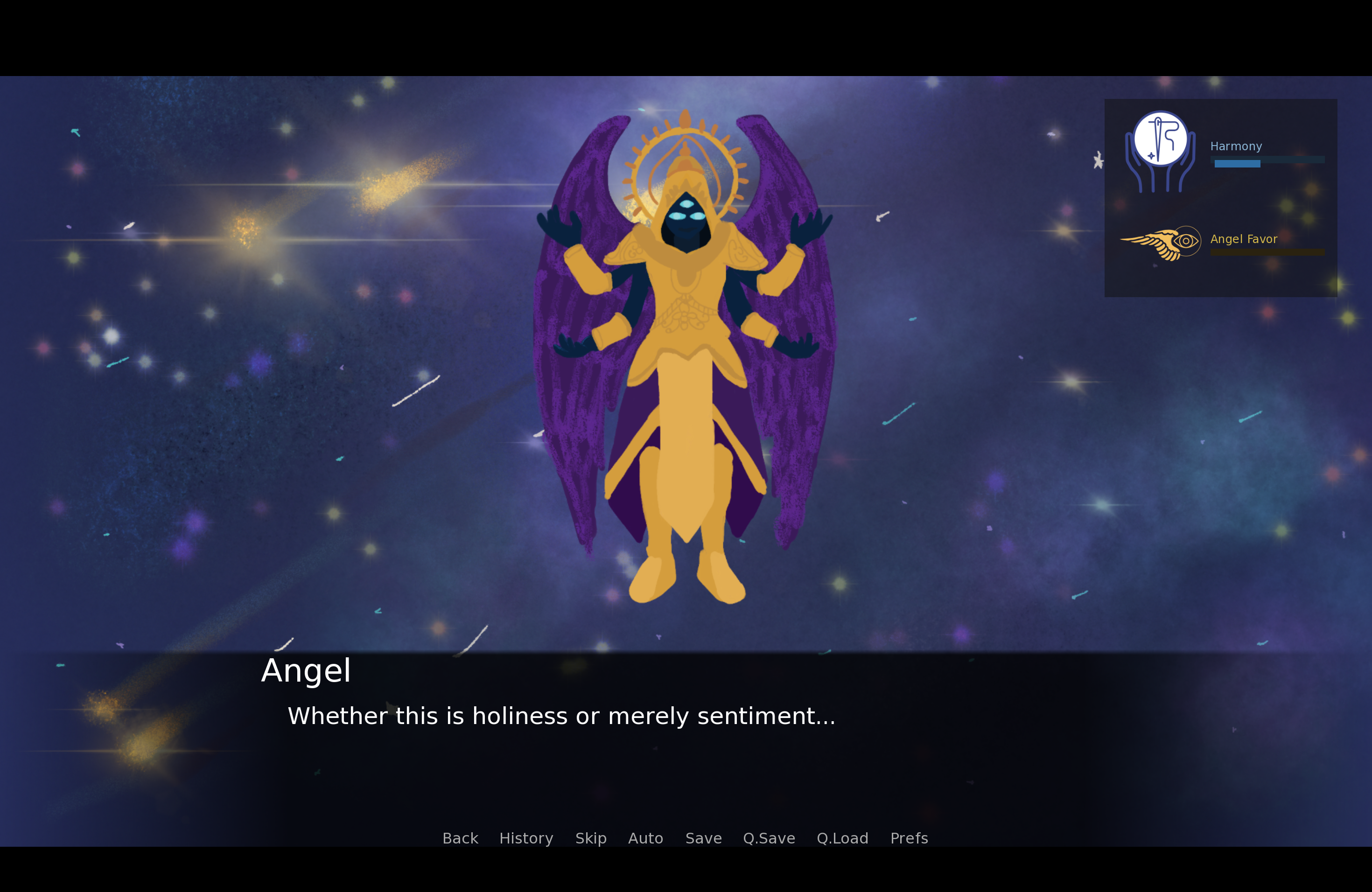
The HUD must be visible at all times. The player must always be aware they are being measured. But the choices that move each bar should only become legible in retrospect, after the consequences have played out.
This constraint came directly from the research: the experience of being inside a system of measurement you didn't design and can't fully interpret is itself the point. The HUD as permanent, opaque presence was the formal solution.
▸ THE TWO VARIABLES
The player arrives as a sinner accustomed to complicity. Raji, a newcomer, feels strangely familiar — triggering memories of the human world. Being cruel to Raji distances the player from the other sinners. Being kind draws the Angel's ire. Doing neither keeps the player isolated, moving nowhere. The gold options are the most distasteful choices. They feel like shortcuts and cost you in ways the interface doesn't announce.
Building purgatory:
the world, the characters, the choices
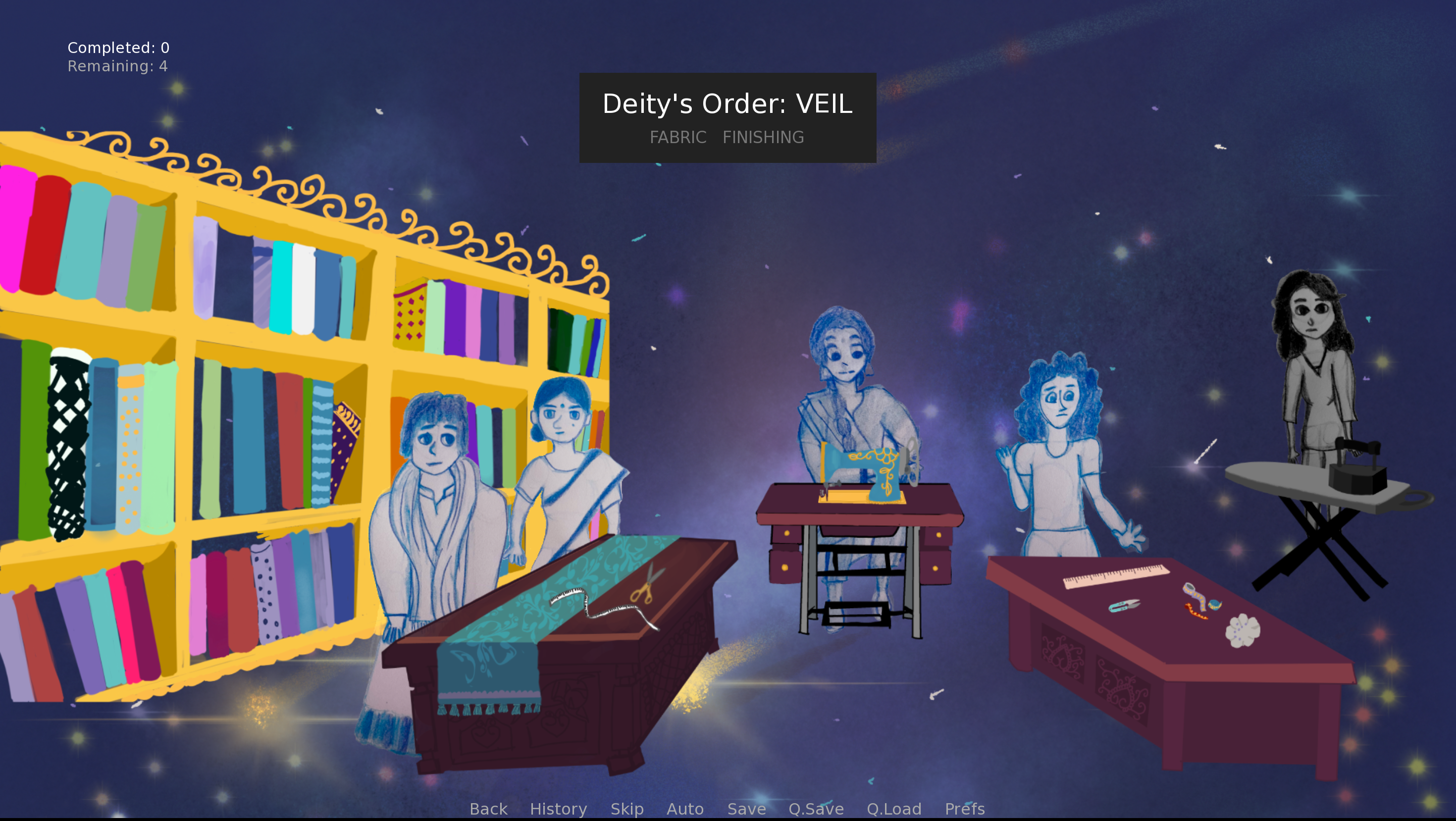
The boutique emerged as the central space because of its dual valence: commerce and aesthetics, labour and beauty, compliance and craft. A place where beautiful things are made under conditions that are not beautiful — which is a description of most of the fashion industry and also of a great deal of creative labour. The setting is cosmic in its design and domestic in its stakes.
The character roster grew from that centre. The Angel is not a villain; she is middle management — the enforcer of a system she is also inside, doing her job with the conviction that the system works. Raji is a newcomer whose presence destabilises the player's hard-won equilibrium. You are navigating the relationship between those two figures and what they ask of you.
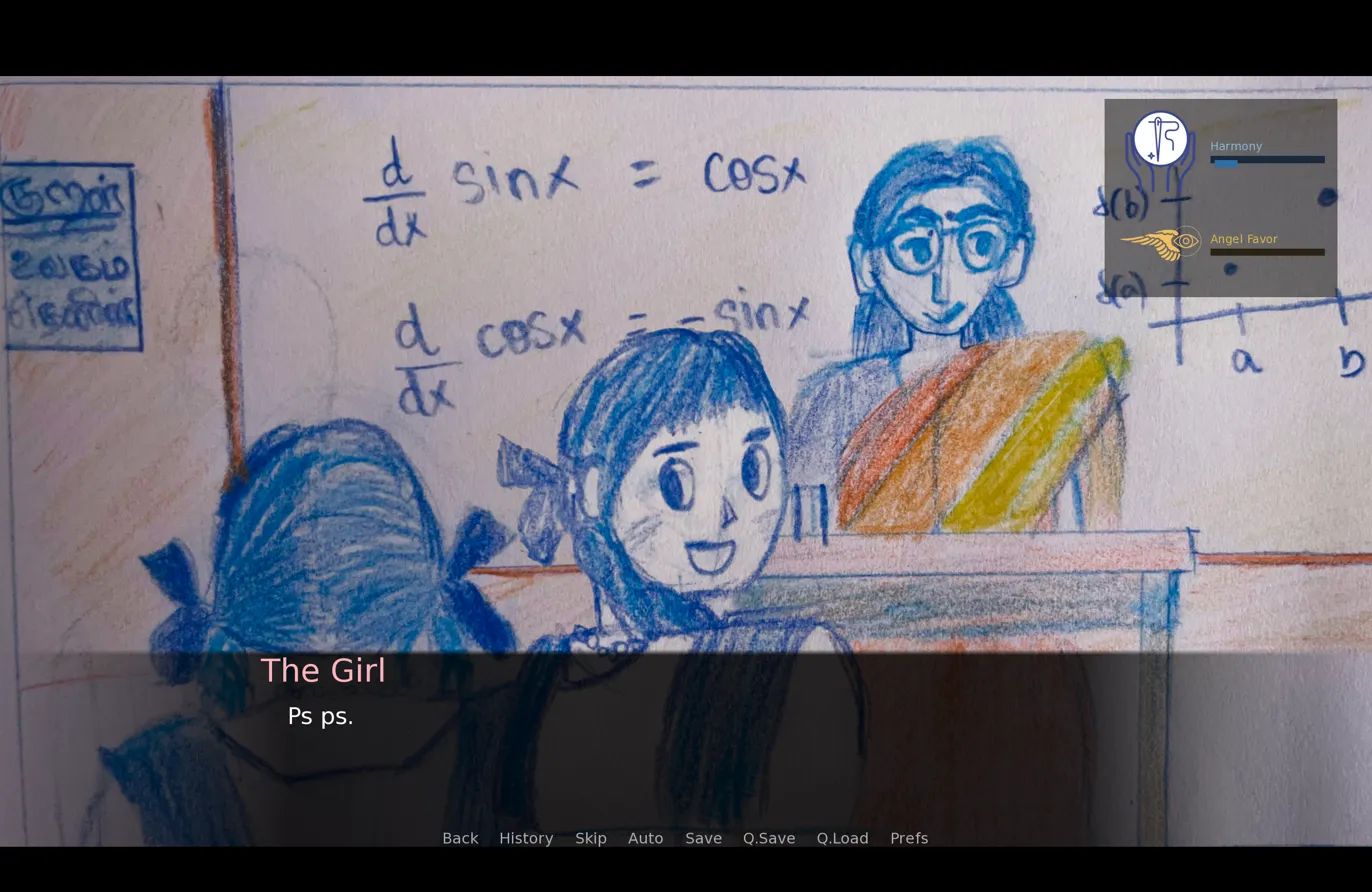
The visual design carries the politics too. The afterlife scenes are hand-painted and cosmic — saturated, formal, enormous in scale. The flashback scenes are drawn on actual notebook paper, scanned. The human world looks handmade in ways the divine world does not. This is not an arbitrary aesthetic choice: it is a statement about where intimacy and imperfection are permitted to exist.
The three-act structure runs parallel narratives: the player's labour in the boutique, the memories Raji surfaces, and the slow clarification of what the HUD has been tracking all along. The two variables are designed so that maximising one costs you in the other. High Harmony means solidarity with the collective at the cost of advancement. High Angel Favor means the system's enforcer likes you, which comes at a social cost. There is no good playthrough. There are only honest ones.
"Some choices are marked in gold. They feel like shortcuts. They cost you in ways the interface doesn't announce."
Building in
the dark
Built in Ren'Py, a visual novel engine with a Python backbone. The HUD required custom screens and persistent variable tracking across scenes. The branching script carries multiple paths toward three distinct endings.
Each iteration responded to playtester feedback:
What players
actually did
Playtesting happened in EMDD 630 with peers. Every playtester could identify what the HUD bars were tracking. The more interesting finding: players felt guilty about choices they had consciously made — not because the game told them to, but because the branching structure makes complicity impossible to attribute to chance. You chose. The bar moved.
The ludonarrative harmony comes from consequence. The mechanics don't describe the tension between solidarity and compliance. They reproduce it.
Workers'
Strike
Collective action prevails. The system cracks. Briefly. The most emotionally satisfying ending — and the hardest to reach.
Absorbed
You become what you arrived in. The boutique continues. Players who felt most guilty were often here.
Endless
Cycle
No resolution. The work goes on. The thread never ends. The most unsettling — players recognised themselves.
"The endings are not ranked. The game does not tell you which one is right. That absence is the point."
The next iteration addresses art direction (character redraw), script revision based on playtester feedback about pacing in act two, and the introduction of a glossary system for players unfamiliar with the mythological references. The core mechanic is not under revision. It worked.